

Choosing the right moving company in Dubai can feel stressful, especially with so many choices. Many people find that moving costs here can range from AED 500 to over AED 30,000. This shows how much prices and service quality can change.
A little research goes a long way. Simple questions help protect your things and keep away bad surprises on moving day. Here are easy tips you should not miss before hiring movers.
Key Takeaways
- Always check if the moving company has a Dubai Department of Economic Development (DED) trade license and VAT registration. Ask for proof of insurance, like goods-in-transit coverage, to protect your things.
- Get a detailed written quote after the movers visit your home or office. Make sure all costs—such as packing materials, lift bookings, labor hours, and storage—are listed to avoid surprise fees.
- Moving in Dubai can cost from AED 500 up to over AED 30,000. Companies with more years of experience often manage building rules better and know local paperwork like NOC permits and elevator bookings.
- Some buildings need move-in or move-out permits with documents like Ejari certificates. Apply for these 3–4 days before or you may be denied entry on moving day by security staff.
- Before moving day, take photos of valuable items and important areas to prove their condition. Stay present during loading and unloading so you can spot missing or damaged stuff right away before paying the final bill.
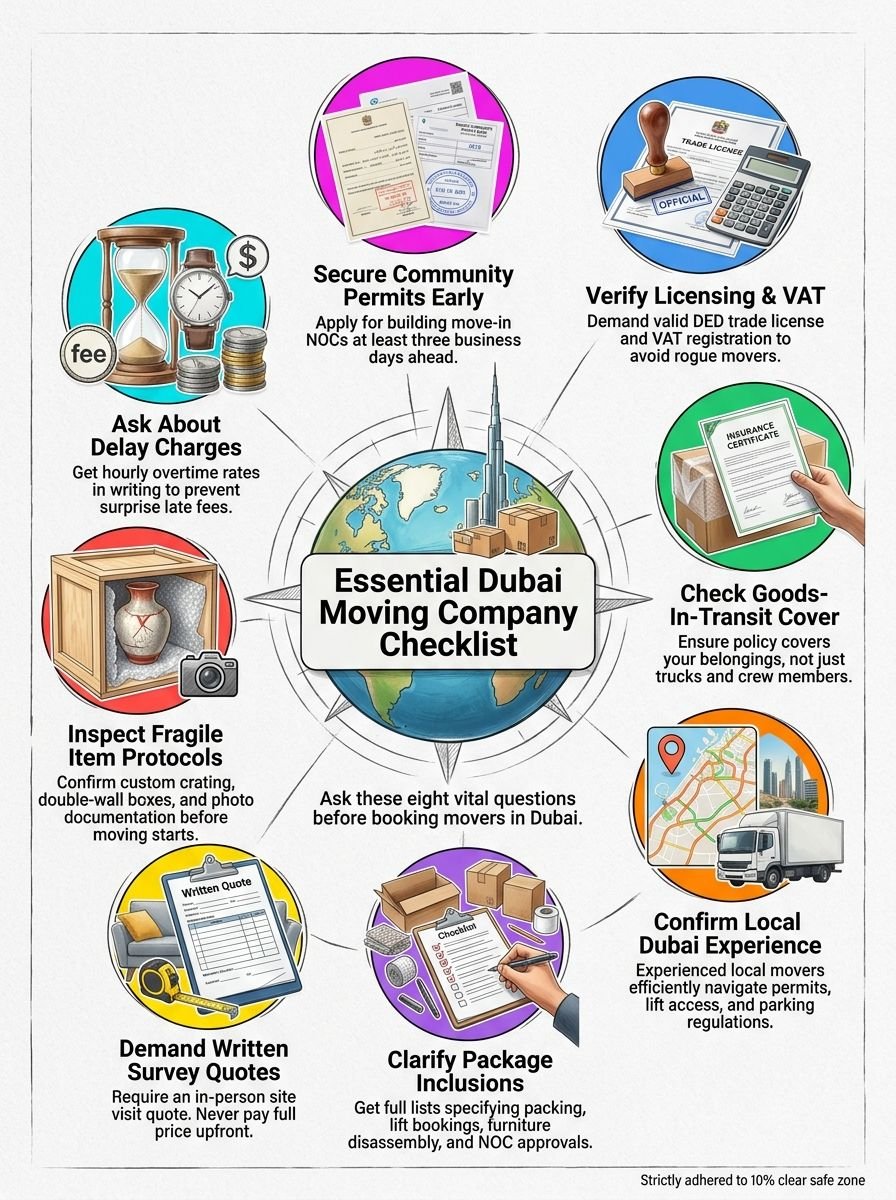
Are You Licensed and Insured?

I always ask to see a valid Dubai Department of Economic Development (DED) trade license before I book. A real moving company will show me their current DED license, and it must list relocation or moving activities.
If they are not VAT registered, I walk away; all professional movers in Dubai have a VAT registration certificate as proof of compliance.
Insurance is key for my peace of mind. Not every mover covers the items being moved; some only insure their own trucks and staff. “Goods-in-transit insurance protects your things if something goes wrong,” my friend once told me, and now I check for this coverage myself.
The right mover gives clear evidence—like a copy of their insurance policy with claims limits and exclusions spelled out.
I never skip checking the legal company name on the Invest in Dubai portal to verify credentials.
A reliable company should have both proper licensing and goods-in-transit coverage before touching anything of mine. TaskRight does extra verification by looking into licenses, current insurance documents, even claims history.
That’s the kind of authenticity I look for so there are no surprises during my move in or out of any place in Dubai.
How Many Years of Experience Do You Have in Dubai?
I always ask, “How many years have you been operating in Dubai under your current trade license?” because this tells me a lot about the movers’ experience with local rules and building types.
Movers who know apartments, villas, office towers, and local tenancy contracts simply work better—they move faster and break less stuff. If a company has only one or two years in Dubai, I start to worry they may not handle Dubai’s access problems well.
International movers such as Allied or AGS often charge 30–50 percent more than local firms. They offer high packing standards and big global networks but might cost much more for my relocation needs.
Some well-reviewed Dubai movers give similar quality at cheaper rates; they understand permits like NOCs, tricky service lifts, and crowded parking which saves me both time and money on move day.
I look at crew training levels too; strong teams finish jobs quickly without delays or extra costs from damage or poor logistics. TaskRight helps by showing mover profiles—including past moves around the city—so I see real ratings before picking someone for my home or office move.
What Services Are Included in the Moving Package?
Experience in Dubai matters, but so do the specific services you get on moving day. I always ask about every detail included in the moving package before I sign anything.
- Most companies split their service into three categories: basic, standard, and full-service. I make sure to ask which one fits my needs.
- Basic packages handle loading, transporting, and unloading boxes or furniture only. This means I pack myself and disassemble beds or tables before move day.
- Standard moving packages usually include packing materials, help with packing, disassembly and assembly of furniture, and even booking the building’s service lift. For apartments especially, those lift bookings can add AED 200 to AED 1,000 in extra fees.
- Full-service moves cover special packing for fragile goods like art or kitchenware. These also often include handling NOC approval from building management; some buildings need 24 to 72 hours’ notice for this paperwork.
- Professionals take on more workers for large homes and villas. My last villa move had eight movers split across two trucks because we needed lots of things moved at once.
- Fragile items like mirrors or fine china need professional wrapping and boxing. I double-check if this costs more under their quote.
- Some companies offer storage if my new home is not ready yet. These storage solutions help when move-out dates do not match move-in dates.
- The price depends on what is included—packing supplies, crew size, truck trips, lift booking fees—all of these can change my final bill a lot.
- Office moves may need even more paperwork with building management or special timing since most towers limit moves to weekdays between 9 AM and 5 PM.
- Movers should always give a full list of what’s covered after they inspect my property in person so there are no surprise charges later on.
Can You Provide a Detailed Written Quote After a Survey?
I always ask for a detailed written quote after the moving company visits my home or office. A site visit lets them see everything, so they can give a true estimate, not just a phone guess.
Reputable movers break down every cost in the quotation—packing materials, disassembly and reassembly, lift bookings, and NOC handling. I make sure every fee appears on paper to avoid surprise costs later.
A good mover puts their hours of service on the written estimate. Some only promise vague time frames; this often leads to extra charges at the end. Comparing each line item helps me spot hidden fees before I choose who to hire.
No trustworthy company asks me to pay 100 percent upfront—I only put down 30–50 percent as deposit before work starts.
A proper quote means no guessing games or shock bills when it’s all over.
Next, I’ll check how these companies handle fragile or high-value items during the move.
How Do You Handle Fragile or High-Value Items?
Fragile or high-value items like marble tables, fine art, pianos, and glass need special care. I always tell movers about these pieces early so they bring the right packing materials.
My last move included a large TV and some expensive artwork; the team used bubble wrap, foam sheets, and custom crates for protection. Double-wall cartons kept my books safe, while wardrobe boxes carried my clothes without wrinkles.
Movers also used mattress covers for all beds and stretch film to keep drawers closed in transit.
Before packing started, I took clear photos of every fragile item from different angles. This step helped with documentation in case anything got damaged later. After delivery, I checked each piece before signing any forms or marking the job complete; only then did I fill out any documents as needed for insurance claims.
Insurance policy limits can be strict per item or for a whole shipment; those details were made clear up front during booking since damages packed by owners are not covered under most plans.
Having everything fully documented avoided stress if disputes happened after moving day ended.
What Happens If the Move Takes Longer Than Expected?
Extra time can mean extra charges. I always ask if the company has overtime or hourly rates in writing. Many quotes only cover a set number of hours on-site, which is based on crew size and access to the building.
My villa may need 4–8 movers, but an apartment often uses just 2–3 movers, causing delays with a small team.
Missing service lift bookings create problems too; these lifts may only be available from 9 AM to 5 PM on weekdays and a few hours Sunday for some buildings like Nakheel. If I do not get needed building access or NOC approved before moving day, my move could stop until things clear up, adding more costs and wasting time waiting at security gates.
Clear communication with my moving company about timing helps avoid surprise fees and chaos in my schedule.
Do You Offer Storage Options for Unmatched Moving Dates?
I have faced delays in moving before, like when my new home was not ready or the elevator booking changed last minute. Large villa moves often need extra time or external storage during part of the transition.
I always ask if the company has secure and accessible storage options for these unmatched moving dates. The fees are usually separate from my main relocation quote, so I check that they itemize every cost clearly.
The movers help organize temporary storage when building NOCs are slow or move-in dates shift without notice. My items stay safe inside these facilities until it is time to move them out again.
I make sure to ask about insurance coverage while my things are stored, since this gives me peace of mind during busy transitions or long moves for homes and offices alike. Next, I focus on permits needed at both sites, checking if the movers will assist with getting a move-in or move-out permit as part of their service.
Can You Assist With Move-In and Move-Out Permits?
Some moves need more than storage, they also need proper permits. In Dubai, moving into or out of an apartment or office building often means getting a move-in or move-out permit from property management.
Big names like Emaar Community Management and Nakheel require these permits before they allow any movers on-site. Applying for a No Objection Certificate (NOC) should happen at least 3–4 working days ahead; Emirates Living accepts applications with just one business day’s notice.
For Nakheel communities, elevator access is strict—Monday to Saturday between 9 AM and 5 PM, Sunday only from 10 AM to 1 PM.
I work with these rules every week. Each building asks for detailed documentation: Ejari certificate, Emirates ID, passport copy, visa page, tenancy contract, mover’s license details, truck plate numbers—even worker ID lists.
Security will check all documents at the gate before allowing entry. If something is missing or late, they turn the movers away right away; no exceptions given by security staff on the actual moving day.
I always confirm permit fees and steps early because every community has its own process and price list for permits and certificates of access.
Who Will Oversee and Manage the Move on Moving Day?
A moving company should assign a supervisor or manager to oversee all logistics on moving day. Last time I moved, my assigned supervisor coordinated with the building concierge and security for service lift access.
This person kept everything on schedule and handled any timing or entry issues that came up. My crew needed their names and Emirates ID copies ready, because our community—Nakheel—required those details for building entry.
I made an access checklist for the movers: building name, unit number, move date, time slot, truck plate number, driver’s mobile phone, worker list, elevator number, and security contact.
The supervisor managed it all with clear communication. Damage to elevators or corridors can risk losing refundable deposits; having one point of contact reduced mistakes during loading and unloading inventory.
If something went wrong or a dispute happened over property handling or transportation timing, I knew exactly who to call right away.
What Should I Prepare Before Moving Day?
Moving in Dubai takes planning. I always set up key tasks a few days before the big date.
- Apply for move-in or move-out approval and book the service elevator at least 3–4 working days ahead, as building management will need this time.
- Make sure all tenancy documents are ready; Ejari must be registered, costing AED 177.75 online or AED 220 at the Trustee center.
- Confirm my utilities (DEWA, Etisalat, du) transfer and secure a service lift slot two weeks before moving.
- Collect and organize documents like Ejari, Emirates ID, passport, visa, signed tenancy contract, mover’s license, truck plate number, and worker identification list.
- Label valuables with clear tags so nothing is missed during inventory and prepare a detailed list of all items one week before relocation day.
- Take photos of my apartment entrance, walls, door frames, large furniture pieces, the service elevator area, fragile valuables, and appliance control panels to document their condition in case damage happens.
- Store both digital files and printed versions of all permits plus access approvals in an easy-to-find place for quick checking by any building guard or manager.
- Plan to stay present at both addresses on moving day; watch as everything is loaded then unloaded to avoid confusion about lost or damaged items.
- Hold off on paying the final amount until every item is safely delivered inside my new home or office and checked for breakage after inspection with staff from the moving company.
Conclusion
Choosing the right moving company in Dubai is not easy but asking these ten questions helps a lot. I always check their license, insurance, and written quotes before saying yes. Small details like storage options or who manages moving day can make things much smoother.
By staying alert for red flags and reading all papers carefully, I protect my belongings and avoid problems later. Careful planning brings peace of mind on your big moving day!
FAQs
1. What should I ask about a moving company’s experience in Dubai?
Start with their years of service, then check if they know the city well. Ask if they have handled moves like yours before, and see if they can manage both small apartments and big homes.
2. How do I find out what services the moving company offers?
Ask for a full list of services up front. This includes packing, loading, transport, and unpacking. See if they provide packing materials or storage options too.
3. Why is it important to ask about insurance when hiring movers in Dubai?
Insurance protects your things during the move. Always ask what coverage is included; also check how claims work in case something breaks or goes missing.
4. Which questions help me understand costs before choosing a mover?
Request a clear price quote that lists all charges with no hidden fees; confirm what is covered by this price such as labor or supplies so you know exactly what to expect on your bill at the end of your move in Dubai.
Leave a Reply