
Moving to the UAE can feel confusing and stressful, especially with all the new rules. Many people wonder where to start. It surprised me when I learned that expats make up almost 89% of the UAE’s population.
That is a lot of people facing the same challenges! In this blog post, you will find clear tips about visas, housing, schools, health insurance, and ways to settle in. Keep reading if you want your move to be a bit easier!
Key Takeaways
- Expats make up about 89% of the UAE population, showing that many people face the same moving challenges.
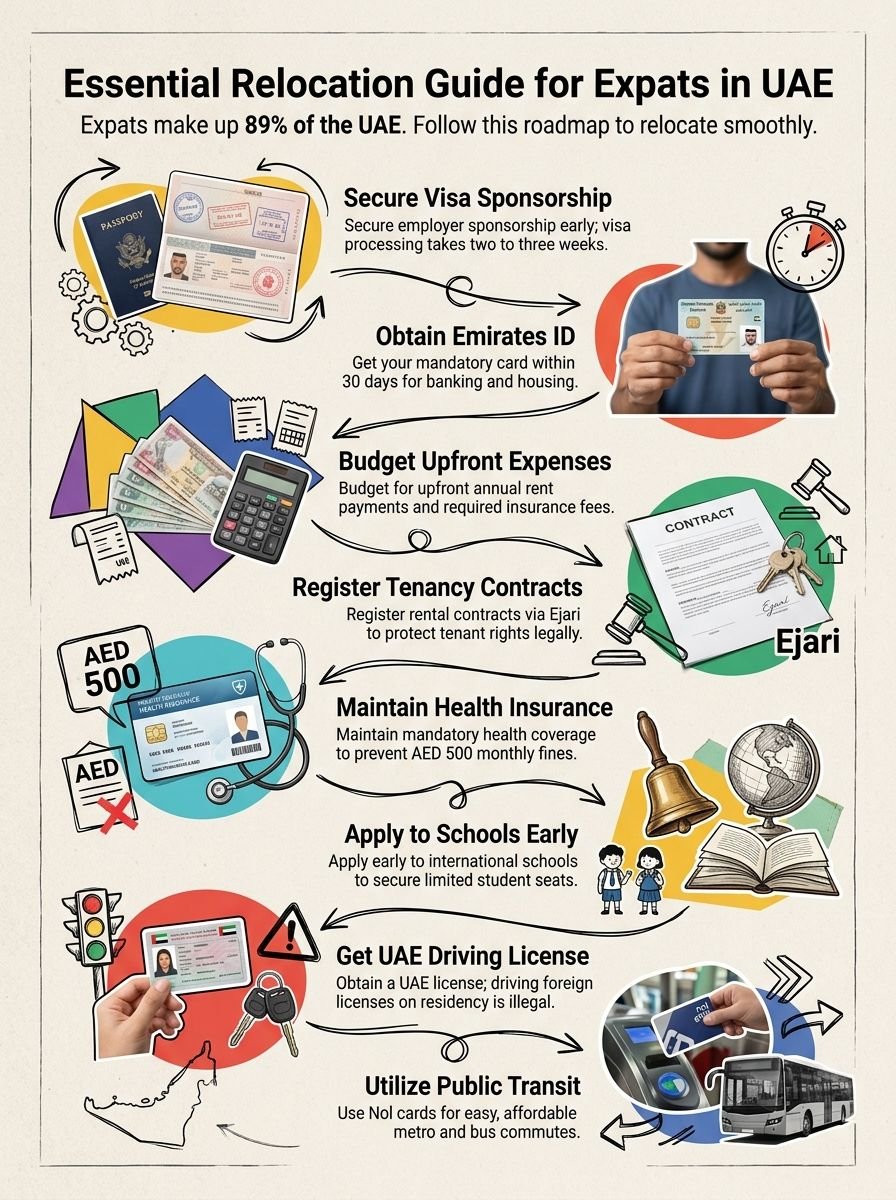
- You need a residence visa and Emirates ID to live in the UAE. A work visa is often sponsored by your employer and takes two to three weeks. Without legal papers, fines can reach $82,000 for employers and jail or deportation for employees.
- The cost of living is high. One-bedroom apartments in Dubai city center average $2,421 per month. Rent is usually paid yearly upfront, but some places allow monthly or quarterly checks.
- Health insurance is required by law for everyone in Dubai. Missing coverage results in fines of AED 500 ($130) per person each month.
- Dubai has over 220 international schools with English as the main language and worldwide curriculums, making it easier for expat children to settle. Popular areas like Dubai Marina are favored by expats due to good schools and easy commutes.
Visa and Immigration Essentials

I found that sorting out my visa and paperwork made moving a lot smoother, so I started early with gathering the documents. Knowing about things like Emirates ID steps helped me feel ready for life in the UAE.
Work permits and visa requirements
Getting a work permit and visa is a big step for moving to the UAE. I made sure to check every detail before my move.
- My residency visa needed an employer sponsor, as listed in my job contract.
- UK passport holders like me got a 30-day visa on arrival in Dubai; my passport was valid for at least six months.
- For my work visa application, I prepared my passport, photos, medical exam results, and signed work contract.
- In the private sector, my residence visa was valid for two years. For public sector jobs, it would last three years. Both can be renewed.
- It took about two to three weeks to process my visa with employer sponsorship. Without a sponsor, waiting time could be longer.
- Once I received my residence visa, I could sponsor immediate family members. They had 30 days to get their own residence stamp.
- I followed all rules because penalties for illegal work in the UAE are strict. Employers may face up to two months in jail or fines reaching $82,000. Employees caught working without a legal permit risk two to three months in prison, deportation, and fines of $27 for each day they stay illegally.
These steps helped me move with confidence and peace of mind.
Understanding the Emirates ID
After sorting out work permits and visa requirements, I begin the next step for living in the UAE. Every resident, including expats like myself and my dependents, must have an Emirates ID.
Issued by the government, this small plastic card is key to daily life here.
I use it as proof of residence when opening a local bank account or registering a tenancy contract for my new home. Healthcare services ask for it too. “Your Emirates ID opens doors in the UAE,” said one neighbor who moved last year.
Family members arrive with an entry residence visa and need to get their own Emirates ID within 30 days along with a residence stamp. The law requires every resident to keep their Emirates ID valid; renewal of every residence visa can’t happen without one either.
Without an Emirates ID, I cannot access many important services like healthcare or banking in Dubai. This identification connects me officially to banks, hospitals, landlords, and more from day one in my new country.
Financial Preparation
I set aside money for the move, because expenses can add up quickly in the UAE. I also got ready to handle my finances in a new country, which made things much easier for me.
Setting a budget for moving costs
Setting a budget helped me avoid surprises during my relocation to the UAE. I listed all key expenses, like visa fees, housing deposits, insurance costs, and utility setups. In Dubai, landlords often expect upfront rent for one year; though some now allow payment with two or four checks each year.
School fees varied a lot depending on the institution, so I checked them before making choices.
I made sure to plan for health insurance too since it’s required for everyone living in the UAE. Missing coverage can mean fines of AED 500 ($130) per month for each person. Eating out added up fast—a small meal cost $12.80 and dinner for two averaged about $81.69 at nicer places.
Consulting a UAE relocation specialist gave me clear advice on handling all these moving costs and setting the right budget from day one.
Opening a local bank account
Opening a local bank account is one of my initial tasks after arriving in Dubai. Having an account helps me manage my salary and pay for rent, utilities, and other daily expenses.
- I need to hold a residence visa before starting the process, which is a rule for all banks in Dubai.
- To open an account, I visit a local branch or book an appointment online. Many major banks are familiar to Westerners, like BNP Paribas, NatWest, Credit Agricole, Barclays, Citibank, and HSBC. Local Islamic banks also serve expats like me.
- I must prepare several documents. These include my passport, Emirates ID card, proof of address in the UAE, and a no-objection letter from my employer that shows my job role and salary.
- The bank checks each document for verification. Sometimes this takes several days before I can use the account fully.
- Opening a bank account lets me accept salary deposits from my employer right away once it becomes active.
- Having an account means I can make payments for rent and utilities with ease and track my expenses better.
- Banking here gives me access to international money transfers and multicurrency accounts. This makes sending money home or traveling much easier in daily life.
Accommodation and Cost of Living
I looked at many apartments before picking one that fit my budget, and I learned housing prices can change a lot from place to place. Rent, utilities, and daily expenses may surprise you if you don’t plan ahead.
Finding the right place to live
Looking for housing in the UAE, I focused on places close to my work and nearby schools. Many expats choose neighborhoods like Dubai Marina, Jumeirah, or Umm Suqeim for their easy access to jobs and good international schools.
The school year runs from August to June, so moving during summer helped my family settle before classes began.
I checked if gated communities fit our needs since they offer extra security and shared amenities. Landlords often require tenancy registration online; this step protected my rights as a tenant.
Some employers even offered me a housing advance that got deducted from my monthly pay, which really helped with upfront costs. Before signing anything, I made sure every fee was clear, including maintenance charges and utility bills.
In Dubai’s freehold areas, expats like me can buy property without needing residency papers; it gave me more choices for settling down long-term.
Understanding rental agreements and costs
Understanding rental agreements and their costs helps me avoid surprises, especially with all the rules and prices in the UAE. Here is a simple breakdown to help me understand what to expect.
| Aspect | Key Details / Facts | What It Means for Me |
|---|---|---|
| Payment Schedules | Annual rent payments are standard, but monthly and quarterly options have become more available. | I may need to provide a full year’s rent upfront, though I can often negotiate for monthly or quarterly checks. |
| Average Rental Prices | One-bedroom in city center: $2,421.57/month. One-bedroom outside city center: $1,434.73/month. Three-bedroom in city center: $4,513.80/month. Three-bedroom outside city center: $3,070.52/month. | I should calculate my budget carefully. City living costs more, but outside areas offer better value. |
| Municipality or Housing Fees | Fees can be linked to the annual rental value of the property. | I must include these fees in my moving budget as they are charged separately from rent. |
| Tenancy Agreement Registration | Rental contracts must be registered to protect tenant rights; Ejari in Dubai is an example. | Registering my contract is required, so I get legal protection as a tenant. |
| Maintenance & Utilities | Tenants pay for maintenance charges and utility costs. | I am responsible for repairs, utility bills, and service charges unless specified otherwise. |
| Buying Property Options | Expats can buy freehold properties. AED 750,000 investment gives me a 2-year visa, AED 2 million gives a 10-year Golden Visa. Only for properties in designated areas. | If I buy, I might get residency or a Golden Visa, depending on my investment and the area I buy in. |
Health and Insurance Requirements
I make sure to check what health insurance I need, because rules can be strict here. Choosing a good plan gives me peace of mind if I ever get sick or hurt.
Mandatory health insurance policies
I had to get private health insurance right away for my Dubai visa. My policy was valid for at least a year, with the option to renew every year. Health coverage included inpatient service, outpatient care, maternity, and even mental health support.
I made sure to choose an approved provider from Dubai’s official list of insurers.
For my work visa, my employer paid for my medical insurance. If I brought family or dependents, though, their coverage became my responsibility as their sponsor. When applying under investor or retiree visas like the Green or Golden Visa, buying a full health insurance policy fell on me alone.
Missing this step cost too much; fines ran AED 500 (about $130) per person each month without proof of cover and AED 1,000 ($270) if emergency insurance was missing. The rules sounded strict but kept everyone safe in case of illness or accident while living here in the UAE.
Choosing the right health insurance provider
Making the right choice for health insurance kept me up at night before my move. The process can seem tricky, but breaking it down helped me a lot. Here’s a quick look at what I focused on when choosing a provider for the UAE:
| Key Point | My Experience & Advice |
|---|---|
| Local Approval | I checked that my insurer is approved by Dubai authorities. Dubai Insurance Company underwrites William Russell’s policies, so I felt confident with their official backing. |
| Types of Coverage | Basic employer plans did not cover what my family needed. I compared options for dental, maternity, and mental health. Many expats, including me, picked international health insurance for these added services. |
| Cost of Care | Healthcare in Dubai is expensive. Major surgeries can start at $8,170. I wanted a strong plan that covers emergencies and keeps costs down if something happens. |
| Portability | I might move again, so I chose a plan with international coverage. This way, I can take my insurance with me if I relocate to another country in the future. |
| Plan Comparison | I compared several providers’ plans, checking for coverage limits and costs. It helped me avoid surprises later. I made sure the plan fits my family—emergency room, maternity, and mental health are required here by law. |
| Visa Requirements | Renewing my UAE residency visa meant I needed to show proof of valid health insurance every time. I chose a provider known for fast paperwork and ease of renewal. |
Education Options
I checked out great schooling choices for my child, and it made settling in much easier. Higher education is strong here too, offering a variety of subjects to study.
International schools for expat children
Moving to the UAE with children, I quickly saw how many international schools are here, especially in Dubai. The number is impressive, and it made my search for the perfect fit both exciting and a bit challenging at the start. Here are the key points I found about international schools for expat kids, based on my own experience and research:
| Topic | Details |
|---|---|
| Total International Schools in Dubai | Dubai has over 220 international schools. That is more than most cities I have lived in before. |
| Curricula Available | I noticed British and American curriculums are popular, but many other international options are available, too. |
| Language of Instruction | English is the main language in most schools, making it easier for expat children to adjust. |
| Multicultural Environment | I saw schools with children from all over the world. These schools celebrate many cultures, which helped my child feel welcome fast. |
| School Fees | Fees can vary a lot. Some schools charge just a few thousand dirhams per year, while others go over AED 100,000. |
| Academic Year | The school year for most runs from August to June. This matched my child’s previous school calendar, so the transition was smooth. |
| Enrollment Procedures | Paperwork can be a handful. I needed to submit passports, residence visas, and my child’s vaccination records. Most schools want these documents before offering a seat. |
| Seat Availability | Many popular schools fill up quickly. I applied early to avoid disappointment, especially in well-known schools. |
| Support for Newcomers | Staff at several schools guided my child through the new system. They offered extra classes and buddy programs to help with the adjustment. |
Dubai gives me access to many higher education opportunities. Top international universities run branch campuses here, offering business, engineering, medical, and arts programs. I see foreign universities welcoming expat students from all over the world.
If I join an accredited program in Dubai, I can get a student visa and study for degrees that people respect internationally.
Scholarships and financial aid help some students cover tuition costs. The government supports these schools to attract global talent like me. Local institutions often partner with international universities, so I find different study options and pathways available.
My friends have taken advantage of this system and earned good degrees without leaving the city.
Transportation and Getting Around
I need to learn how people travel every day, whether I want my own car or prefer public ways. Getting around is simple once I know my options and what suits me best.
Obtaining a UAE driving license
Getting a UAE driving license can feel like a big step, but the process is clear if you follow each rule. I needed this license soon after getting my residency, as city life almost requires it.
- After receiving my residence visa, I learned I could not drive with my old license. Driving with only a foreign license on residency status counts as a legal offense in the UAE.
- Rental car companies allowed me to use my home country’s license only while holding a tourist visa. Once my residency started, they required a valid UAE driving license.
- I began by gathering needed paperwork. My Emirates ID and residence visa were required for all steps in the application process. Some people also include their passport copies and photos.
- Because I am not from one of the countries with license conversion agreements, I registered at an approved driving school in Dubai. People from places like the UK or Germany can sometimes convert their licenses directly without extra tests.
- New residents from countries outside these agreements must pass both theory and practical driving tests. The driving school guided me through each requirement and scheduled lessons before exams.
- Fees grew quickly. Between application charges, eye test costs, classes at the driving school, and test fees, budgeting became essential for me. The cost often goes over 4,500 AED for lessons and paperwork.
- After passing every test and paying all fees, authorities issued my new UAE driving license within days. Traffic police informed me that insurance is mandatory—not just for owning cars but even when renting them in Abu Dhabi or Sharjah.
- Car rental is common among expats because of high temperatures and large distances between office buildings or homes.
Sorting out transport is key for daily life here; next up is understanding local public transport options and how to get around comfortably.
Public transportation options
After sorting my UAE driving license, I was excited to try other transit options in the city. Dubai makes it easy to commute with many public transportation choices for new residents.
- Dubai’s metro system gives fast, clean rides across the main business and shopping areas. I found stations in key parts of the city like Burj Khalifa and Mall of the Emirates.
- Modern buses run on set routes, linking neighborhoods with workplaces and malls. My early days in Dubai were simple because bus schedules are online and usually on time.
- Taxis wait at every corner, day or night. All taxis here use meters for fares so I never worried about being overcharged.
- Women-only sections on some metro trains and buses made me feel safe during busy hours or late trips home.
- Nol cards make payment quick on metros, buses, and trams. I could reload my card at kiosks or even small stores all over town.
- Rental costs were not an issue as public transport saved me money compared to owning a car. Fares fit most budgets, which is good for people just moving into a new place.
- City infrastructure supports smooth transfers between trains, buses, and taxis; finding accessible stations was not hard as signs were clear in English.
- Detailed route maps and apps helped me plan commutes from my apartment to my office building without stress.
- Buses offered ramps for wheelchair users, showing that accessibility matters here.
- Public transit felt safe due to CCTV cameras at stations and regular police presence.
Trying these transit options gave me freedom before buying a car. Public transportation connected me with many parts of Dubai while keeping everyday costs down.
Conclusion
Moving to the UAE brings many new things, but it can be simple with good planning. I checked rules for visas, housing, and health insurance before arriving. Each step made settling in smoother and helped me feel at home sooner.
With careful choices, life here is both exciting and easy to manage. Starting a new chapter in the UAE truly feels rewarding every day.
FAQs
1. What are the first steps for expats planning to move to the UAE?
Start by gathering your important papers, like passports and work permits. Check visa rules early since they can change often. Make a list of things you need before you leave, such as housing options and schools if you have kids.
2. How do I find a place to live in the UAE as an expat?
Look online for apartments or houses in safe neighborhoods near your job or school. Many expats use local real estate agents; they know about good deals and can help with paperwork. Always visit places in person when possible before signing any contract.
3. What should I pack when relocating to the UAE?
Pack light clothing because it is hot most of the year, but also bring some warm clothes for winter evenings indoors where air conditioning can be strong. Bring chargers that fit local plugs and any medicine you may need since certain items might not be easy to find right away.
4. Are there tips for adjusting to life in the UAE after moving?
Learn simple words from Arabic; this helps with daily tasks and shows respect for locals’ culture. Join groups or clubs made just for new arrivals; these offer support and friendship while settling into your new home quickly feels easier when others share advice from their own moves.
Leave a Reply